
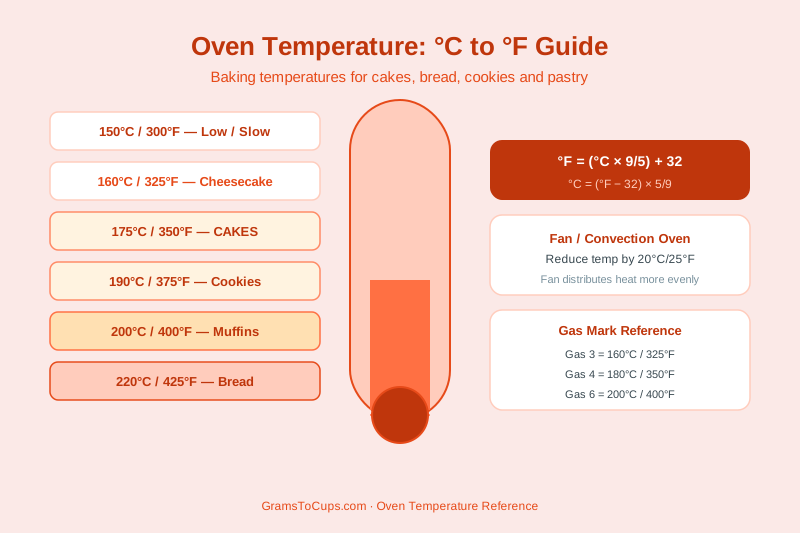
Oven temperature is one of the most critical variables in baking — yet it's also one of the most confusing, because recipes from different countries use different scales: Celsius in Australia, UK and Europe; Fahrenheit in the USA; and gas marks still used in older UK and Irish recipes. Getting the temperature wrong by even 15–20°C can mean the difference between a perfectly golden cake and a raw centre or burnt crust.
The Conversion Formula
The mathematical relationship between Celsius and Fahrenheit is fixed:
- °C to °F: multiply by 9, divide by 5, then add 32 — or: °F = (°C × 1.8) + 32
- °F to °C: subtract 32, multiply by 5, divide by 9 — or: °C = (°F − 32) ÷ 1.8
- Quick approximation: double the °C and add 30 (gives you within ±10°F for baking ranges)
Complete Baking Temperature Conversion Chart
| Celsius (°C) | Fahrenheit (°F) | Gas Mark (UK) | Description | Used For |
|---|---|---|---|---|
| 120°C | 250°F | ½ | Very low | Meringue drying, slow-roast |
| 150°C | 300°F | 2 | Low | Cheesecake (water bath) |
| 160°C | 325°F | 3 | Low-moderate | Cheesecake, dense cakes |
| 175°C | 350°F | 4 | Moderate | Standard cakes, cookies |
| 180°C | 355°F | 4–5 | Moderate | Layer cakes, quick breads |
| 190°C | 375°F | 5 | Moderate-hot | Chocolate chip cookies |
| 200°C | 400°F | 6 | Hot | Muffins, scones, biscuits |
| 210°C | 410°F | 6–7 | Hot | Pizza, flatbreads |
| 220°C | 425°F | 7 | Very hot | Crusty bread, roasting |
| 230°C | 450°F | 8 | Extremely hot | Sourdough, Neapolitan pizza |
| 260°C | 500°F | 10 | Maximum heat | Self-cleaning cycle, pizza stone |
Fan / Convection Ovens: The 20°C Rule
Fan (convection) ovens use a fan to circulate hot air, which distributes heat more evenly and cooks food faster. Because heat reaches food more efficiently, fan ovens run effectively 15–25°C hotter than conventional (static) ovens at the same dial setting.
The standard rule: reduce the recipe temperature by 20°C (or 25°F) when using a fan oven. So if a recipe says 180°C in a conventional oven, use 160°C in a fan oven.
Many modern ovens offer both conventional and fan modes. For baking cakes, conventional mode gives more even results for delicate batters; fan mode is better for roasting and crisping. Always check your oven manual to confirm which mode is active.
Oven Thermometers: Why You Need One
Most residential ovens are inaccurate by 10–25°C. The dial says 180°C but the actual oven temperature could be anywhere from 160°C to 205°C. This is why two bakers following the same recipe get different results from the same setting.
An oven thermometer costs less than the ingredients in one failed batch of macarons. Place it in the centre of your oven and check your actual temperature — then adjust your dial accordingly. Once calibrated, you'll get consistent results every time.
Oven temperature calibration is especially critical for recipes like soufflé, macarons, croissants and custard tarts, where a 10°C variance means failure. For everyday baking like muffins, cakes and cookies, a 10–15°C variance is usually within tolerance. Use our leavening guide to ensure your rise is on point regardless of temperature.
Frequently Asked Questions
What is 180°C in Fahrenheit for baking?
180°C equals 356°F (rounded to 355°F in most recipes). This is one of the most common baking temperatures for layer cakes, pound cake and quick breads. In fan ovens, reduce to 160°C / 320°F. In older US recipes, this is often listed as the ever-popular "350°F" — note that 350°F is actually 177°C, slightly less than 180°C, but the difference is negligible in practical baking.
What temperature do you bake most cakes?
Most standard layer cakes and round cakes bake at 175–180°C (350–355°F) in a conventional oven. This temperature is hot enough to set the structure and create a golden crust while giving the centre time to cook through. Very large cakes (3 layers, thick slabs) may bake better at 160°C (325°F) to avoid a dry exterior before the interior sets. Cupcakes and muffins often use 190–200°C for a domed top.
How do I convert a recipe from fan oven to conventional?
Add 20°C (25°F) to the fan oven temperature to get the conventional oven equivalent. So a recipe written for a fan oven at 160°C becomes 180°C in a conventional oven. Also check baking time — conventional ovens may need 5–10 minutes longer than fan ovens at the same nominal temperature, since heat distribution is less efficient without the fan.
What does Gas Mark 4 equal in Celsius and Fahrenheit?
Gas Mark 4 = approximately 180°C / 350–355°F. Gas mark conversions are approximate because gas ovens have different heat distribution characteristics from electric ovens. The commonly used gas mark scale runs from ¼ (very low, ~110°C) to 10 (extremely hot, ~260°C), with each increment representing roughly 14°C.
Why does baking temperature matter so much?
Oven temperature controls multiple simultaneous processes: starch gelatinisation (structure setting), protein coagulation (eggs setting), fat melting, sugar caramelisation and the Maillard reaction (browning). Each of these happens at a specific temperature range. Too low, and the cake sets too slowly — fat leaks out, structure doesn't form, crust doesn't brown. Too high, and the outside sets and browns before the inside is cooked — you get a domed, cracked top and raw centre.
My oven runs hot — how do I adjust?
If your baked goods consistently brown too quickly, burn on the bottom, or cook faster than recipe timings suggest, your oven runs hot. Verify with an oven thermometer. Then: (1) set your dial lower than the recipe — if your oven runs 20°C hot, set it 20°C below the recipe temperature; (2) use an insulated or dark baking pan, which heats more slowly; (3) place your baking rack one notch lower; (4) cover loosely with foil after the first two-thirds of baking time to prevent over-browning.