
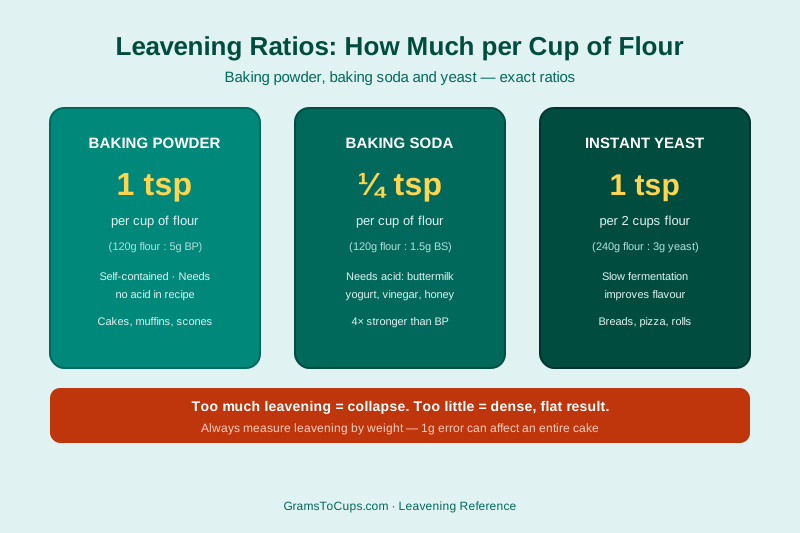
Leavening agents — baking powder, baking soda and yeast — are responsible for the rise and lightness of virtually every baked good. Getting the quantity right is one of the most common points of failure in baking. Too much leavening causes a batter to rise dramatically and then collapse, leaving a sunken, gummy centre. Too little produces a dense, flat, heavy result. The good news: there are reliable ratio guidelines that work for almost any recipe.
Why Leavening Amount Matters
Leavening agents create carbon dioxide (CO₂) gas, which gets trapped in the batter or dough and expands during baking, causing the rise. The amount of leavening determines how many gas bubbles form and how much expansion occurs. But baked goods can only trap a limited amount of gas — if too much CO₂ is produced, bubbles merge and burst, the structure collapses before it can set, and you end up with a fallen centre or dense, rubbery result.
Standard Leavening Ratios by Flour Weight
| Leavening Type | Per Cup Flour (120g) | By Weight | Notes |
|---|---|---|---|
| Baking powder | 1 tsp (4.8g) | 4% of flour weight | For recipes without acidic ingredients |
| Baking soda | ¼ tsp (1.5g) | 1.25% of flour weight | Needs acid in recipe to activate |
| Instant yeast | ½ tsp (1.5g) | 1.25% of flour weight | Standard bread — slow rise for flavour |
| Active dry yeast | ½–¾ tsp (2g) | 1.5% of flour weight | Slightly more needed due to lower potency |
When to Use Baking Powder vs Baking Soda
The choice between baking powder and baking soda depends on whether your recipe contains acidic ingredients:
- Use baking soda when the recipe contains an acid: buttermilk, yogurt, sour cream, lemon juice, vinegar, brown sugar (mildly acidic), cocoa powder (natural), or honey.
- Use baking powder when there is no significant acid in the recipe — it contains its own acid (cream of tartar) to activate the soda.
- Use both when you want maximum rise and some acid is present but not enough to activate all the baking soda. Many recipes use baking soda for flavour neutralisation and baking powder for extra lift.
Baking soda is approximately 4 times stronger than baking powder. If you run out of baking powder, substitute: 1 tsp baking powder = ¼ tsp baking soda + ½ tsp cream of tartar. See our baking powder vs soda guide for the full chemistry.
Gram Weights for Precise Leavening
| Leavening | ¼ tsp (g) | ½ tsp (g) | 1 tsp (g) | 1 tbsp (g) |
|---|---|---|---|---|
| Baking powder | 1.2g | 2.4g | 4.8g | 14.4g |
| Baking soda | 1.5g | 3g | 6g | 18g |
| Cream of tartar | 0.75g | 1.5g | 3g | 9g |
| Instant yeast | 0.8g | 1.6g | 3.1g | 9.3g |
Altitude and Leavening Adjustments
At high altitude (above 1,000m / 3,000ft), air pressure is lower. Leavening gases expand more rapidly and the batter sets more slowly — this causes over-rise and collapse at sea-level leavening quantities. At altitude, reduce baking powder by 15–25% and reduce baking soda by a similar amount. Use our tablespoon to grams guide to calculate precise reductions.
Frequently Asked Questions
How much baking powder per cup of flour?
The standard ratio is 1 teaspoon (4.8g) of baking powder per cup (120g) of all-purpose flour. This 4% ratio produces a reliable rise in most cake, muffin and quick bread recipes. For chocolate cake or other dense batters, you may need slightly more (1¼ teaspoons per cup). For delicate sponges, slightly less (¾ teaspoon) prevents over-rising and collapsing.
What happens if I add too much baking powder?
Too much baking powder causes the batter to rise too quickly in the oven, forming a large dome — then collapsing before the structure sets, leaving a sunken, gummy centre. The over-leavened cake also develops a bitter, metallic taste from the excess sodium bicarbonate. If you accidentally doubled the baking powder, you can sometimes rescue the batter by making a double batch of everything else — but this only works if you haven't already baked it.
Can I use baking powder instead of baking soda?
Yes, but use 3 times as much — baking soda is 3–4× more potent than baking powder. Replace ¼ teaspoon baking soda with ¾–1 teaspoon baking powder. However, if the recipe uses baking soda specifically to neutralise an acid (like buttermilk or cocoa), replacing it with baking powder may leave a slightly sour or sharp taste in the finished product, since the acid won't be neutralised.
How do I know if my baking powder is still active?
Test it: add 1 teaspoon of baking powder to ¼ cup of hot water. If it bubbles vigorously, it's still active. If there's minimal or no reaction, it's expired — replace it. Baking powder has a shelf life of approximately 12–18 months once opened. Store it in an airtight container away from heat and humidity. The lid should click shut firmly — moisture inside the container will cause premature activation and early expiration.
Does altitude affect how much leavening I use?
Yes, significantly. At high altitudes (above 1,000m), lower air pressure means gas bubbles expand more rapidly. This causes baked goods to rise too fast and then collapse before setting. Reduce baking powder by 15–25% above 1,000m, and by 25–30% above 2,000m. Also increase oven temperature by 10°C to help set the structure faster before collapse occurs.
Why does some baking powder say "double-acting"?
Most modern commercial baking powder is double-acting, meaning it produces CO₂ gas twice: once when mixed with liquid (immediate rise in the batter) and again when heated in the oven (second rise during baking). The first reaction begins developing structure; the second provides the main oven spring. Single-acting baking powder (rare today) only reacts once, requiring you to get the batter into the oven quickly before the gas escapes. All major commercial brands (Rumford, Clabber Girl, UK Baking Powder) are double-acting.