
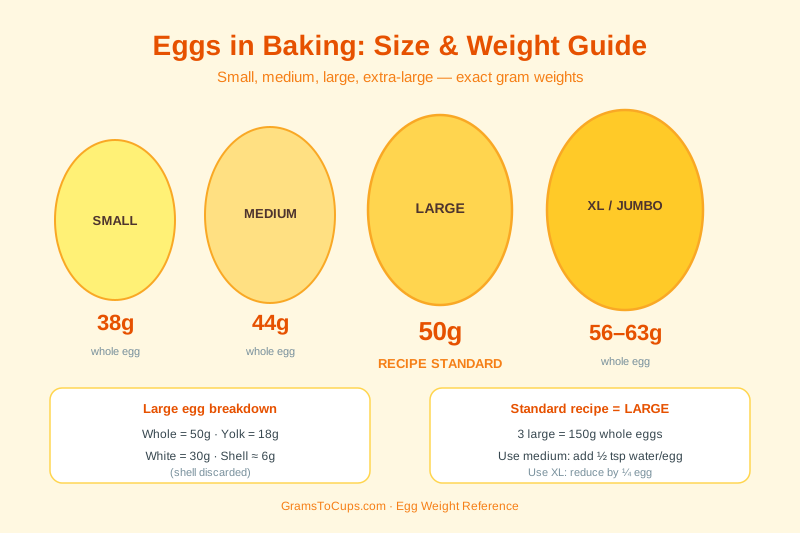
Eggs are one of the most structurally important ingredients in baking. They provide structure (protein), moisture (water content), fat (yolk), leavening (trapped air), emulsification (lecithin in the yolk) and colour. Getting the egg quantity right matters far more in baking than in cooking, and that starts with understanding that eggs vary dramatically in size and weight.
Almost all baking recipes written in English assume large eggs. If your recipe doesn't specify a size, use large. If your eggs are a different size, this guide shows you exactly how to adjust.
Egg Size Weight Chart
| Size | Whole Egg (g) | Yolk (g) | White (g) | Notes |
|---|---|---|---|---|
| Small | 38g | 14g | 22g | Rare in UK/US supermarkets |
| Medium | 44g | 16g | 26g | Common in Europe |
| Large | 50g | 18g | 30g | Recipe standard |
| Extra-Large | 56g | 20g | 34g | Common in US supermarkets |
| Jumbo | 63g+ | 22g | 39g | From larger breeds |
The shell accounts for approximately 10–12% of the egg's total weight — around 6g for a large egg. All weights above exclude the shell.
What Each Part of the Egg Does in Baking
Understanding what yolks and whites do separately helps you understand why egg size and substitutions matter:
- Whole egg: contributes structure, moisture, fat and emulsification. The workhorse of baking.
- Egg yolk: rich in fat and lecithin. Adds richness, colour and emulsifying power. Used alone in custards, hollandaise and enriched doughs.
- Egg white: mostly water (88%) and protein. Used alone in meringues, angel food cake and macarons. Provides lift without fat.
How to Substitute When You Have the Wrong Size
If a recipe calls for large eggs and you only have medium or extra-large, weigh your eggs and adjust quantity. The target total weight (in grams) is the key number:
| Recipe Calls For | Target Weight | Use Instead |
|---|---|---|
| 1 large egg (50g) | 50g whole | 1¼ medium or ⅞ XL |
| 2 large eggs (100g) | 100g whole | 2½ medium or 1¾ XL |
| 3 large eggs (150g) | 150g whole | 3½ medium or 2⅔ XL |
| 4 large eggs (200g) | 200g whole | 4½ medium or 3½ XL |
The practical approach: for most recipes up to 3 eggs, the size difference between medium and large is small enough to be negligible. For 4+ eggs, weigh your total egg weight and aim for the target grams. You can beat eggs together and use part of the mixture for partial amounts.
Eggs at Room Temperature vs Cold
Most baking recipes assume room-temperature eggs. Cold eggs don't emulsify as well with fat and can cause butter-based batters to split. To quickly bring eggs to room temperature: place them in a bowl of warm (not hot) water for 5–10 minutes. See our guide on butter temperature in baking for a related tip.
Egg-Free Substitutes in Baking
When eggs are unavailable or you're baking for dietary restrictions, these substitutes replace one large egg (50g):
- Flax egg: 1 tbsp ground flax + 3 tbsp water. Rest 5 min to gel. Best in dense muffins and cookies.
- Chia egg: 1 tbsp chia seeds + 3 tbsp water. Best for structure, not lift.
- Aquafaba: 3 tbsp chickpea brine. Excellent for meringues and macarons.
- Banana: ¼ cup mashed (60g). Adds moisture and sweetness. Works in banana bread and muffins.
- Applesauce: 3 tbsp (45g). Good for moisture but no lift.
- Commercial egg replacer: follow packet instructions. Works in most applications.
Frequently Asked Questions
How many grams is a large egg without the shell?
A large egg without the shell weighs approximately 50 grams: roughly 18g yolk and 30g white. The shell itself weighs about 6g. All recipe weights for eggs refer to the edible portion only — never include the shell weight.
Can I use 2 medium eggs instead of 2 large eggs?
In most recipes, yes — the difference between 2 medium (88g total) and 2 large (100g total) eggs is only 12g, which is small enough to be negligible in casual baking. For precision baking (soufflés, delicate sponges, custard), weigh your eggs and aim for 100g total by cracking an extra egg and using part of it.
Why do baking recipes always specify large eggs?
Large eggs became the global recipe standard because they represent the most commonly sold size in North America and the UK. Professional recipe developers test with large eggs for consistency. Using a different size doesn't just change volume — it also changes the ratio of fat to water in the batter, which affects texture, rise and moisture.
How do I measure half an egg?
To measure half a large egg: crack the egg into a small bowl, beat it lightly until uniform, then use half by weight (approximately 25g) or by measuring spoon (approximately 1½ tablespoons). This technique is useful when halving cake or cookie recipes. See our recipe halving guide for more tips.
Do egg sizes affect cookies differently than cakes?
Yes. In cookies, extra egg makes them cakey and puffier; less egg makes them crispier and flatter. In cakes, extra egg adds structure and prevents sinking, but too much makes the cake rubbery. Cookies tolerate egg size variation better than cakes because cookie dough is more forgiving of slight changes in moisture and fat content.
How many eggs is 100g?
100 grams of whole egg (without shell) equals exactly 2 large eggs (2 × 50g = 100g). If using medium eggs, 100g = approximately 2.3 eggs. This makes large eggs particularly convenient for recipes that call for egg weights, since they convert to whole numbers easily.